Publications:
Here you can find my publications:
Working Papers
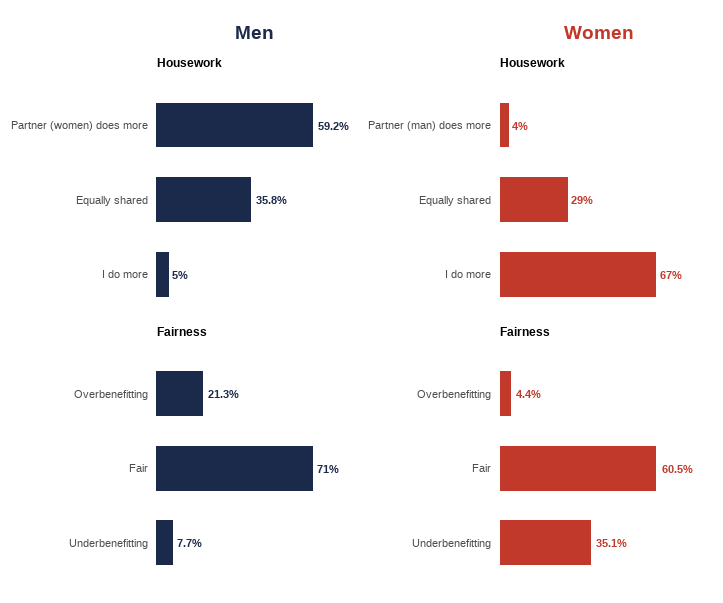
“Till chores tear us apart: Perceived unfairness in household labor division and the risk of union dissolution among different sex couples in Germany”
with Tabea Naujoks (University of Rostock) and Heike Trappe (University of Rostock) — 2026 In Preparation
Abstract
Despite substantial progress toward gender equality, women continue to shoulder a disproportionate share of domestic labor and caregiving responsibilities. While prior research has documented the unequal distribution of household labor, less attention has been paid to how partners perceive these arrangements and whether such perceptions contribute to union dissolution. This study examines how perceived unfairness in the division of labor is associated with the likelihood of separation among different-sex couples in Germany. Drawing on data from the German Family Panel (pairfam) and the German Family Demography Panel Study (FReDA), and estimating piecewise constant exponential hazard models on survival-structured data, we assess how perceived inequities in two domains—paid work and housework—relate to separation risk. Results show that respondents who perceive the overall division of labor in their household as unfair face a higher risk of union dissolution than those who perceive it as fair. For women specifically, perceiving the division of housework as unfair—relative to perceiving it as fair—is associated with a heightened risk of separation, and this relationship is partly explained by broader perceptions of fairness in the overall division of work. The association between perceived unfairness and separation risk is especially pronounced among full-time employed individuals, and particularly among full-time employed women, suggesting that economic autonomy strengthens the capacity to leave relationships marked by unequal labor divisions.
“Parental Leave, Specialization and the Life-Course Accumulation of Inequality”
2026 In Preparation
Abstract
This paper examines the long-run pension accumulation consequences of parental leave duration for first-time mothers in Germany, exploiting the 2007 parental leave reform as a quasi-experimental source of variation in a fuzzy regression discontinuity in time design. The reform replaced a means-tested flat-rate benefit of up to 24 months with an earnings-related benefit capped at 14 months, creating heterogeneous incentives to shorten leave across the income distribution. Using administrative records from the German statutory pension insurance, I instrument leave duration with reform eligibility to estimate its causal effect on earnings-related pension point accumulation over five- and ten-year post-birth windows. Preliminary results show that each additional month of parental leave reduces five-year pension accumulation by 0.074 pension-related earning points, with the pension cost amplifying approximately four-fold over a ten-year horizon, documenting that short-run outcome windows substantially understate the retirement income consequences of extended leave. Effects are concentrated among mothers in the lowest pre-birth income quantiles, for whom the reform generated a strong behavioral response and a ten-year intent-to-treat gain of 0.65 pension-related earning points, equivalent to a permanent increase of 26.51 Euros per month in retirement income, which is roughly equivalent to 2.6% of the average female pension of 2024. The preliminary findings contribute to the literature on the long-run costs of career interruptions and highlight parental leave duration as a significant but underappreciated driver of gender gaps in pension wealth accumulation and, by extension, retirement income security.
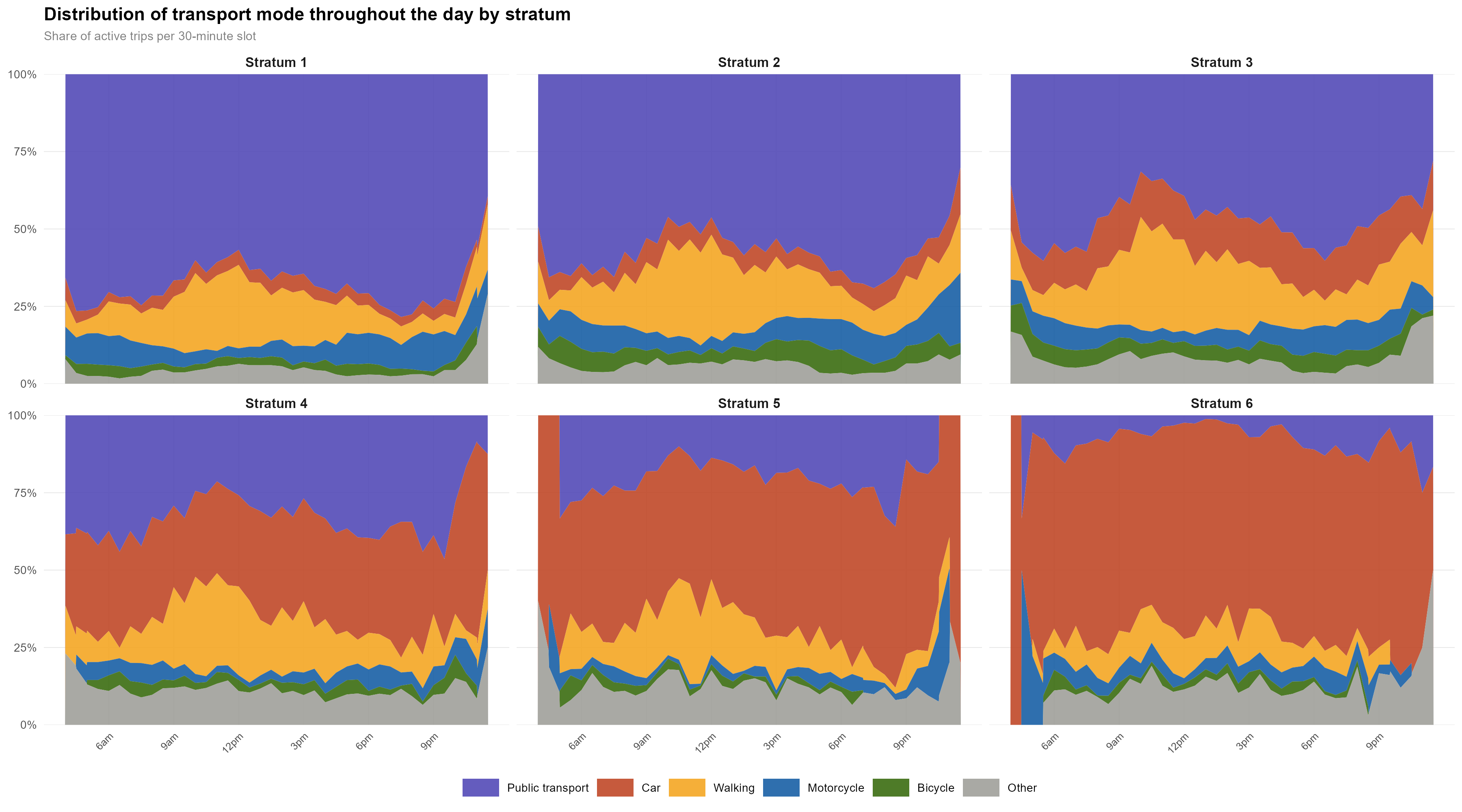
“When and where are women most at risk of harassment or assault in public transport systems? Bogotá as a Case Study”
with Isabella Urbano-Trujillo — 2026 In Preparation
Abstract
Sexual harassment in public transport is not randomly distributed but structured by the intersection of gender and socioeconomic position, particularly in Global South cities. We argue that low-income women’s disproportionate dependence on public transit — their condition as “transit captives” — transforms socioeconomic stratification into an active mechanism of compounded vulnerability rather than a mere correlate of harassment risk. Using the Bogotá Mobility Survey (2023), covering over 85,000 trips with a dedicated sexual violence module, we estimate logistic regression models with zone fixed effects, complemented by sequence analysis of daily travel patterns. Women face a substantially higher probability of harassment than men, with a gap of 11–15 percentage points persisting across all socioeconomic strata. Trip complexity is the most robust predictor of risk, while public transport use and night-time travel are significant only for women. Risk follows a non-monotonic pattern across strata, with strata 2–4 facing higher absolute risk than stratum 1. These findings show harassment is structural, predictable from trip organisation rather than individual characteristics, and suggest that trip simplification and night-time safety measures may outperform awareness campaigns. Stratum and gender interactions confirm the “transit captive” condition, amplifying risk at all socioeconomic levels.
Policy and Technical Research Notes
Co-author of government-issued technical publications
Co-author of two research notes published by the Fundación Interra in Colombia
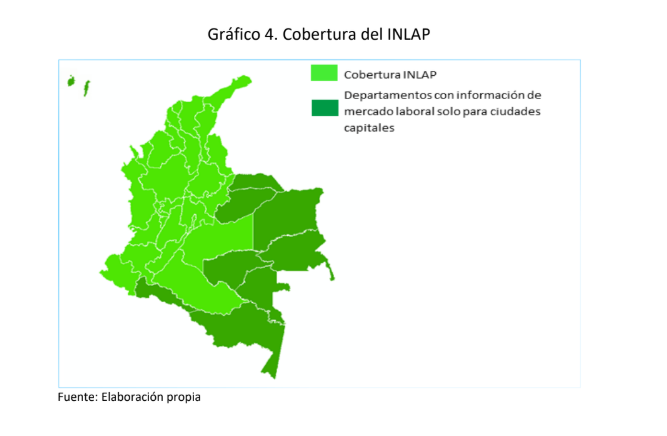
- NT 7: Índice de Inclusión Laboral Poblacional-INLAP / Labor Inclusion Index — with Paola Vanegas, Camila Espinosa and Eduard Arias: The Interra Foundation developed the Labor Inclusion Index for the Colombian Population (INLAP) as the first comprehensive tool to diagnose and measure labor inclusion in Colombia. It addresses structural barriers that prevent vulnerable groups from accessing quality education, job intermediation, and formal employment opportunities.
Other
-
Análisis y propuestas de mejora del instrumento de promoción de Unidades de Apropiación Social del Conocimiento en las Instituciones de Educación Superior en Colombia / Analysis and Improvement Proposals for the Promotion Instrument of Social Appropriation of Knowledge Units in Higher Education Institutions in Colombia - UNESCO technical document co-authored with Verónica Orellana-Navarrete, Ramón Álvarez-Torres, Sofía Ñaña, and Marilyn Garzón.
- Read the document on UNESDOC
- View the related UNESDOC search results